Published by Portland Maine Tree Service
The Honest Ranges
- Small tree, open access (under ~30 ft): a few hundred dollars. Ornamentals, dying birches, the overgrown arborvitae: quick drops with simple cleanup.
- Average yard tree (30–60 ft): roughly $600–$1,500 in Greater Portland. Most maples, oaks, and pines near (but not over) structures land here.
- Large or technical removals (60 ft+, over structures): $1,500–$5,000+. Big white pines over rooflines, trees between houses, anything requiring full sectional rigging.
- Crane-assisted and hazard-tree jobs: the top of the range and beyond. Dead pines too brittle to climb, storm-damaged trunks under tension, monsters over primary bedrooms.
Stump grinding is typically a separate line item ($100–$400 per stump, cheaper bundled); the grinder is its own machine and its own visit unless scheduled together.
What Actually Moves the Price
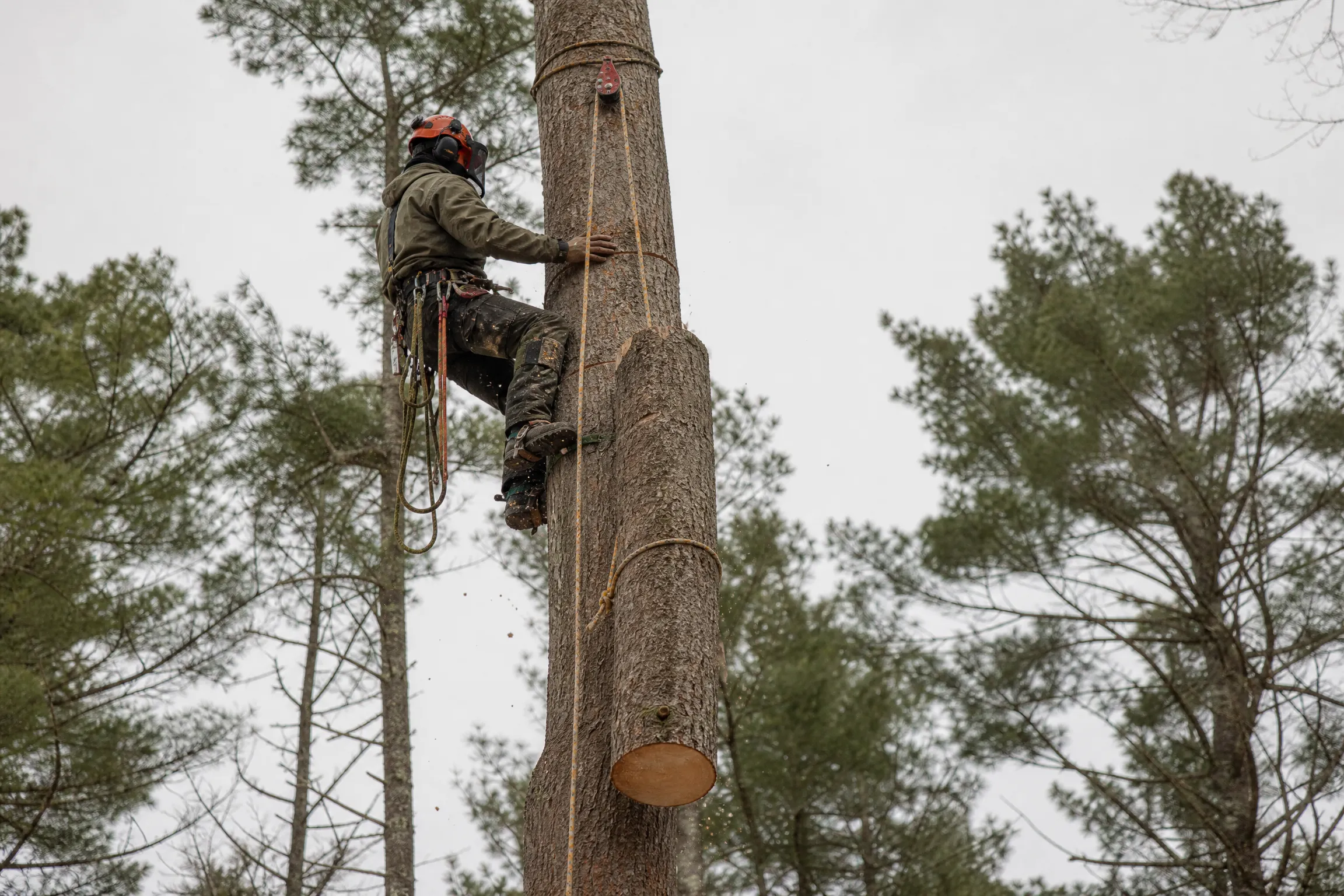
- Targets, not height. A 70-footer in a hayfield gets felled whole in an hour. The same tree between your house and the neighbor's new deck comes down in fifty roped pieces over a full day. You're paying for what the tree could hit.
- Dead vs. alive. Dead and decayed trees can't be safely climbed, which means bucket work or a crane. Every season a dead tree stands, it gets more dangerous, and more expensive.
- Access. Can a chip truck and bucket get near it, or does every pound of tree leave the backyard through a 36-inch gate? Hand-carrying a tree costs real money.
- Rigging complexity. Limbs over the sunporch roof have to be lowered on ropes and pulleys, piece by piece: skilled, slow, insured work. That's the photo at the top of this page, and it's what the middle of every big-tree invoice is buying.
- Cleanup level and wood disposal. Chip-and-haul, wood bucked for your stove, or logs stacked at the road for a buyer; each finishes differently on the bill.
The Cheap Quote Warning
Tree removal is consistently among the most dangerous jobs in America, and Maine takes that seriously: state law requires anyone doing tree work for hire to hold a Maine arborist license and carry at least $150,000 in liability insurance. A bid dramatically under everyone else's is usually missing one or both, which means if the uninsured guy puts a limb through your roof (or a helper in the hospital), your homeowner's policy becomes the insurance. Ask for the license number and the certificate of insurance; here's how to verify both on the state's public list.
When You're Not the One Paying
If a storm put the tree on a structure, your homeowner's insurance typically covers removal from the structure (see the storm cleanup guide). If the neighbor's tree is involved, it's more interesting. And if the tree is a city street tree, it isn't yours to remove, or to pay for (the rules guide covers who owns what).
How to Keep the Price Down (Legitimately)
- Don't wait for dead. The cheapest removal is the one done while the tree can still be climbed.
- Bundle. Multiple trees, or removal plus stump grinding, price better in one visit than piecemeal.
- Schedule off-peak. Winter removals on frozen ground protect the lawn and fill crews' slow season.
- Ask about the wood. Keeping the wood for your stove saves hauling; roadside log-length can offset costs on big pines.
- Consider the alternative. Sometimes the worry driving a removal is really a pruning problem at a third of the price.
Every number in this guide is a range because every tree is a specific puzzle of species, condition, targets, and access. The free written estimate (tree by tree, in writing, no surprises) is the only number that counts.