Published by Portland Maine Tree Service
1. A New Lean, or Fresh Soil Movement at the Base
The most urgent sign on this list. Trees that have always leaned grew that way and built wood to support it. A tree that leaned this season, especially with cracked, lifted, or mounded soil on the side away from the lean, is telling you its root plate is letting go. That's not a monitor-it situation; that's a call-today situation, and it's exactly the tree that comes down in the next storm that "didn't seem that bad."
2. Mushrooms and Conks at the Base or on the Trunk
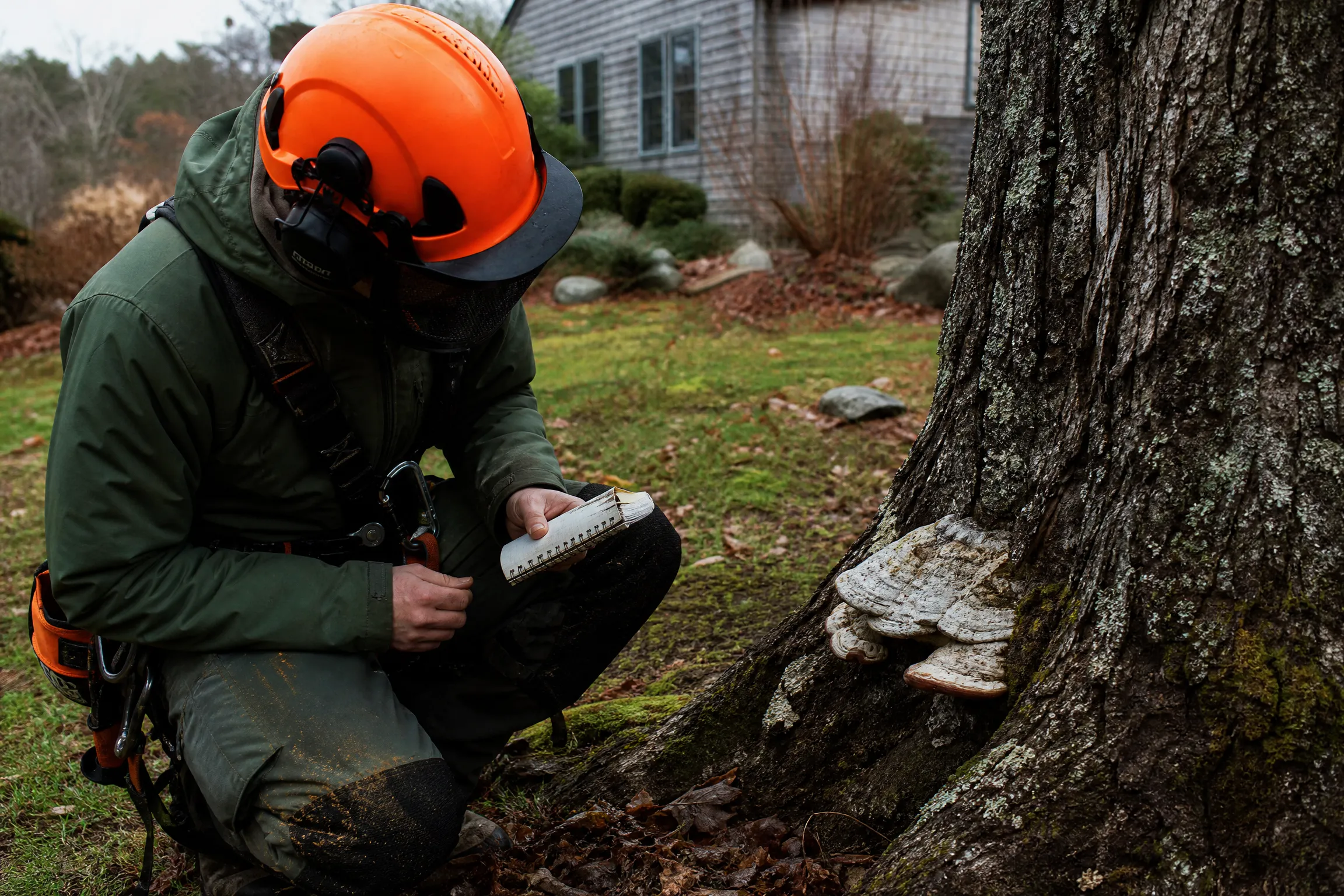
The shelf-like growths in this guide's photo are fungal conks: the visible fruiting of decay fungi that have been eating the tree's structural wood for years. Conks at the trunk base or on root flares mean internal rot where the tree can least afford it. Not every fungus is a death sentence (and lichen is harmless), but conks on the trunk of a big tree near a target is precisely what a professional assessment exists to evaluate, sometimes with a resistance drill that measures how much sound wood is actually left.
3. Vertical Cracks in the Trunk
A visible seam or split running up the trunk, especially one that's new, weeping, or has bark pulling apart at its edges, is a structural failure in progress. Frost cracks (common in Maine maples after hard cold snaps) aren't automatically fatal, but any substantial vertical crack deserves professional eyes before the next big wind load.
4. Deadwood and Hangers in the Crown
Bare limbs in July, big branches with no fine twigs, cracked limbs caught in the crown from the last storm; loggers call them widow-makers for the bluntest possible reason. Deadwood over a roof, driveway, or play area is the most fixable item on this list: a pruning visit removes the hazard while keeping the tree.
5. Cavities, Hollows, and Carpenter Ants
A hole you can see into is missing structural wood; how much matters is an engineering question (trees are tubes; they can lose a surprising amount of center and stand for decades, until they can't). Steady streams of carpenter ants on the trunk are the tell that soft, decayed wood is extensive inside, even when the outside looks fine. Woodpeckers working one spot hard are reading the same signal.
6. Dieback at the Top of the Crown
When a tree starts dying from the top down (thin leafing, bare leader, stunted yellowish foliage up high), it's usually reporting a root problem: compaction, construction damage, girdling roots, drought stress, or root rot. A tree with failing roots can look 80% green and still be losing its grip on the ground. Top dieback in a large tree near targets is an assessment trigger, not a wait-and-see.
7. Bad Architecture: Tight Forks and Topping Scars
Two trunks of similar size meeting in a tight V (arborists: "co-dominant stems with included bark") is the weakest joint in tree architecture; it's where big maples split in half in ice storms. The good news: caught early, it's manageable, and even mature trees can get cabling and bracing that lets the two stems share the load for decades. Second, a tree that was ever "topped" (hacked flat) has regrown a head of fast, weakly attached shoots on decayed stubs; those crowns fail in pieces, routinely.
Reading the Whole Tree
One sign is a conversation; two or more signs on the same tree, or any sign on a big tree over something you can't move, is an assessment. In Maine that opinion comes with a state license behind it, and the honest verdict is frequently not removal: weight reduction, deadwooding, or a cable often buys decades. And when it is removal, done deliberately, on your schedule, it costs a fraction of the same tree handled as an emergency, with a paper trail that matters if the tree is anywhere near a property line.